
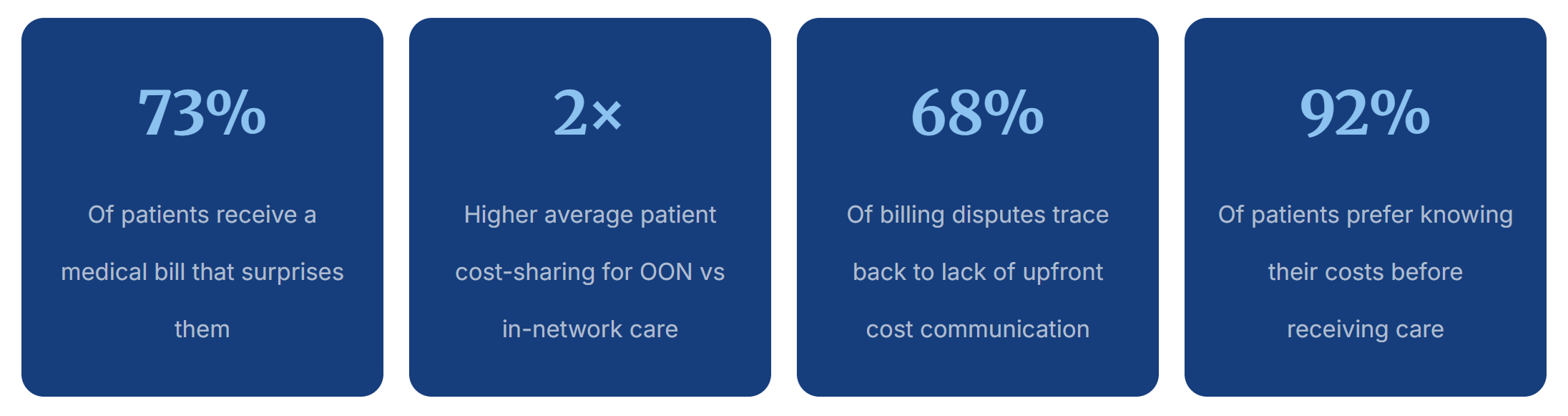
Most billing disputes do not start with a wrong code or a missed claim. They start with a conversation that never happened. When patients understand their out-of-network costs before they receive care, everything that follows becomes easier - for them and for your practice.
What You Will Learn in This Post
When a patient opens a medical bill and sees a number they were not expecting, the first call they make is not to their insurance company. It is to your front desk. That call almost always turns into a dispute, a delayed payment, or a write-off. The root cause in the majority of cases is a gap in patient education, not a billing error.
Out-of-network billing is one of the most misunderstood areas in all of healthcare finance. Patients frequently assume their insurance covers out-of-network care the same way it covers in-network care. They do not understand separate deductibles, higher coinsurance tiers, or balance billing until the explanation of benefits arrives weeks after their appointment.
According to MGMA research, patient collections account for an increasingly large share of total practice revenue as high-deductible plans become the norm. When patients are unprepared for their financial responsibility, collection rates drop and administrative costs climb. The investment in upfront patient education pays back directly in faster payments and fewer disputes.

The phrase "out-of-network" sounds simple, but most patients do not actually understand what it means in practice. Before you can explain their benefits, you need language that cuts through the insurance jargon they have heard but never had properly explained.
Insurance companies build a network by contracting with specific providers, hospitals, labs, and specialists. When those providers agree to a contract, they accept a negotiated, discounted rate for services in exchange for being referred patients covered by that plan. Your insurance company uses its negotiating power to bring that rate down, and you as the patient benefit from lower out-of-pocket costs as a result.
When a provider is outside that network, no contract exists. There is no negotiated rate. The insurance company may still pay a portion of the claim, but it will typically be a lower percentage, based on what the plan defines as the "usual, customary, and reasonable" charge for that service in that area. The gap between what the provider charges and what the insurance pays often falls entirely on the patient.
Simple language that works: "Think of in-network providers as stores that accept your store card at a discount. Out-of-network providers are like paying full price somewhere that does not accept your card. Your insurance may still help with part of the bill, but you will pay more of it yourself."
The most effective way to make out-of-network costs real for a patient is to show them a side-by-side comparison using their actual plan numbers. Generic explanations do not stick. Specific numbers do.
When you verify a patient's benefits before their visit, pull four key data points for both their in-network and out-of-network tiers:
A patient with a $500 in-network deductible and $4,000 in-network out-of-pocket maximum may have a $1,500 OON deductible and an $8,000 OON out-of-pocket maximum. On a $3,000 procedure, that difference can mean the patient owes $600 in-network versus $2,400 or more out-of-network. Showing those two numbers side by side in writing before the visit changes the conversation entirely.
A patient with a $500 in-network deductible and $4,000 in-network out-of-pocket maximum may have a $1,500 OON deductible and an $8,000 OON out-of-pocket maximum. On a $3,000 procedure, that difference can mean the patient owes $600 in-network versus $2,400 or more out-of-network. Showing those two numbers side by side in writing before the visit changes the conversation entirely.
A patient with a $500 in-network deductible and $4,000 in-network out-of-pocket maximum may have a $1,500 OON deductible and an $8,000 OON out-of-pocket maximum. On a $3,000 procedure, that difference can mean the patient owes $600 in-network versus $2,400 or more out-of-network. Showing those two numbers side by side in writing before the visit changes the conversation entirely.
Balance billing is one of the most alarming aspects of out-of-network care for patients, and one of the least understood. It happens when an out-of-network provider bills the patient for the difference between their full charge and the amount the insurance company paid, on top of whatever the patient already owes in cost-sharing.
For example: a provider charges $800. The insurance pays $300 based on their UCR allowance. If balance billing applies, the patient could receive a bill for the remaining $500 in addition to their normal deductible and coinsurance amounts. That is why OON costs can reach figures that feel completely disconnected from what patients expected.
The federal No Surprises Act, which took effect in January 2022, added important consumer protections that your staff should understand and be able to reference. Key provisions include:
However, the No Surprises Act does not cover all OON situations. When a patient voluntarily chooses an out-of-network provider for non-emergency scheduled care, balance billing protections generally do not apply. This is precisely where clear upfront patient communication from your practice becomes the primary protection — for the patient and for your revenue.
For more detail, the CMS No Surprises Act resource center provides updated guidance for both providers and patients.
Knowing what to say is half the challenge. Your front desk staff are not insurance counselors, and they should not be put in a position where they are making promises about what a plan will or will not cover. But they can and should walk patients through the structure of their benefits in a way that sets realistic expectations.
Script for the scheduling call
"Before your appointment, I want to let you know that our practice is out-of-network with your insurance plan. That means your benefits will apply at your plan's out-of-network level and your out-of-pocket costs may be higher than if you were seeing an in-network provider. I'd recommend calling the member services number on the back of your insurance card to ask about your specific out-of-network deductible and coinsurance. Would you like me to go over what we will need from you before your visit?"
Script at the front desk
"We have verified your benefits and wanted to share an estimate of what your out-of-pocket responsibility may be today. Based on your plan's out-of-network coverage, your estimated cost is approximately [amount]. This is an estimate and your final responsibility will depend on what your insurance processes. Do you have any questions before we get you checked in?"
Script for handling patient concerns
"I completely understand this is more than you expected. Because we are out-of-network with your plan, your costs are higher than they would be with an in-network provider. I can connect you with our billing team to go through your options including payment plans, and we can also help you file the claim with your insurance if needed."
Verbal conversations are necessary but not sufficient. Patients forget, misremember, and misinterpret what was said in a busy clinical environment. A well-designed set of written materials reinforces everything your staff communicates and gives you a documented record in the event of a billing dispute.
Every out-of-network patient at your practice should receive the following before care is delivered:
MedDabster's revenue cycle management services include patient billing communication support, including template documents and benefits verification workflows your team can implement immediately. The goal is to make this process systematic rather than dependent on individual staff members remembering to have the conversation.
The connection between patient education and collection rates is not theoretical. Practices that implement structured OON communication protocols consistently report fewer billing disputes, higher collection rates on patient balances, and lower rates of claims being ignored or sent to collections.
The reason is straightforward. When patients are surprised by a bill, their first instinct is to contest it. They assume an error was made because the number does not match their expectations. When patients know what to expect, they receive the bill with context. They may not be happy about the amount, but they are not shocked by it, and they are far more likely to engage with your billing team to arrange payment rather than ignore the statement entirely.
A few structural changes that practices have found most effective:
These are not complicated changes. They are process changes, and once systematized, they require very little additional staff time per patient encounter. If you need support building or improving your patient financial communication workflows, MedDabster's team offers dedicated billing and RCM support services designed specifically for practices navigating complex out-of-network billing environments.
In-network providers have negotiated rates with your insurance plan, meaning the patient pays a lower contracted cost. Out-of-network providers have no contract with the insurer, so the plan pays a lower percentage or nothing at all, leaving the patient responsible for a larger share. The deductible, coinsurance, and out-of-pocket maximum are almost always higher for out-of-network care.
In many cases yes. Without the protections of a contracted rate, an out-of-network provider can charge their full fee and the patient may owe the difference between that charge and what the insurance pays. The No Surprises Act limits this in emergency situations, but for voluntary scheduled OON care, patients should always verify their benefits beforehand and sign a consent form acknowledging their financial responsibility.
Most insurance plans carry two separate deductibles: a lower one for in-network care and a higher one for out-of-network care. Payments made to in-network providers do not count toward the OON deductible, and vice versa. This means patients may effectively have to meet both deductibles in the same year if they receive both types of care, which significantly increases their annual out-of-pocket costs.
Balance billing occurs when an out-of-network provider bills the patient for the difference between their full charge and what the insurance paid, on top of the patient's normal cost-sharing. For example, if a provider charges $500 and the insurance pays $200, the patient could be billed the $300 balance in addition to their deductible and coinsurance. The No Surprises Act restricts this in emergency situations, but it still applies in many planned out-of-network care scenarios.
The most effective approach is proactive communication: verify patient benefits before the visit, provide a written good faith cost estimate in advance, have patients sign a financial responsibility form, and walk them through their out-of-network coverage at the time of scheduling. Practices that implement these steps consistently report fewer disputes, faster payments, and higher patient satisfaction with the billing experience.


