An urgent care center runs on speed. Patients walk in without appointments, get seen within minutes, and expect the same speed from everything else, including the paperwork. But that same speed can work against a practice's revenue if billing cannot keep pace with the volume walking through the door. The centers that get paid fastest are not the busiest ones. They are the ones whose urgent care billing process moves just as fast as their care does.
Urgent care is a different animal from a scheduled primary care visit. There is no appointment book, no advance eligibility check, and often no existing relationship with the patient. A person walks in, gets treated, and leaves, sometimes within twenty minutes. That speed is the entire value proposition of urgent care. But it also means the billing team has almost no lead time to verify coverage, confirm eligibility, or catch a coding issue before the claim goes out the door. When urgent care revenue cycle management is built around that reality instead of fighting it, faster care and faster payments stop being two separate goals and start reinforcing each other.

A typical urgent care center sees dozens of walk in patients a day, each with a different payer, a different plan, and a different reason for the visit. There is no scheduling gap to research eligibility ahead of time, which means real time eligibility verification has to happen at the front desk in the middle of an already busy shift.
Urgent care visits are billed using a mix of evaluation and management codes and urgent care specific S codes, and choosing the correct level depends on documentation that has to be captured accurately during a fast moving encounter. Undercoding leaves money on the table. Overcoding invites a payer audit. Either mistake, repeated across hundreds of visits a month, adds up quickly.
A single day at an urgent care center might include a patient with commercial insurance, one on Medicare, one on Medicaid, one paying cash, and one with an out of network plan. Each of these has different prior authorization rules, different documentation requirements, and a different reimbursement timeline, and the front desk staff handling intake has to sort through all of it in real time.
Urgent care centers are often staffed leaner than hospital based departments, which means the same front desk person checking patients in may also be responsible for collecting copays, verifying benefits, and answering the phone, all during the busiest hours of the day.
Confirming eligibility and benefits before the patient leaves the building, rather than days later during batch processing, catches coverage issues while there is still time to collect a copay or discuss self pay options directly with the patient. This single habit is one of the most effective ways to reduce claim denials downstream.
Giving providers a simple, consistent template for documenting the complexity of each visit makes it far easier for coders to select the correct E&M code or urgent care S code without guessing, which protects both revenue and compliance at the same time.
Same day or next day claim submission shortens the entire reimbursement timeline. A claim that sits in a queue for a week before it is even sent adds that week directly onto the practice's days in accounts receivable, with no benefit to anyone.
Collecting copays, deductibles, and known out of pocket costs at checkout, rather than mailing a statement afterward, dramatically improves patient collections and reduces the amount of revenue that has to be chased down later through statements and calls.
A denial log that only counts how many claims came back does not tell a practice much. Sorting denials by root cause, whether it is eligibility, coding, authorization, or timely filing, shows exactly which part of the process to fix first for the biggest revenue impact.
| Billing Bottleneck | Typical Delay It Adds | Fix That Closes the Gap |
|---|---|---|
| Eligibility checked after the visit | 3 to 7 days | Verify insurance at check in |
| Weekly batch claim submission | 5 to 10 days | Submit claims daily |
| Coding review backlog | 4 to 8 days | Standardized visit documentation templates |
| Patient balance mailed after visit | 14 to 30 days | Collect known balance at checkout |
| Denials reviewed without root cause tracking | Ongoing, compounding | Denial tracking by reason category |
| Stage | Same Day Target | Common Delay Point |
|---|---|---|
| Patient check in and eligibility check | Within minutes of arrival | Manual eligibility lookups |
| Visit documentation and coding | Same day | Incomplete provider notes |
| Claim scrubbing and submission | Within 24 to 48 hours | Batching claims weekly |
| Payer response and posting | 10 to 15 days | Missing prior authorization |
| Patient balance collection | At checkout | Statements mailed later |
Delayed cash flow: Every extra day a claim sits before submission is a day the practice is financing its own operations out of pocket, which becomes especially painful for centers running on thin margins with high patient volume.
Compounding denials: A coding or eligibility error that goes unnoticed in one claim often repeats across dozens of similar visits before anyone catches the pattern, turning a single mistake into a much larger revenue leak.
Patient dissatisfaction over billing surprises: Patients who visit urgent care expect a fast, transparent experience. A confusing bill that arrives weeks later, especially one with an unexpected balance, undermines the trust the practice built during the visit itself.
Staff burnout from constant catch up: When billing tasks pile up instead of flowing through daily, staff spend more time firefighting old claims than handling new ones, which increases errors and turnover in an already lean department.
Worth noting: Many urgent care centers assume slow reimbursement is simply the cost of doing walk in medicine. In reality, the centers with the strongest cash flow are not seeing fewer patients. They have simply removed the delays sitting between the visit and the payment.
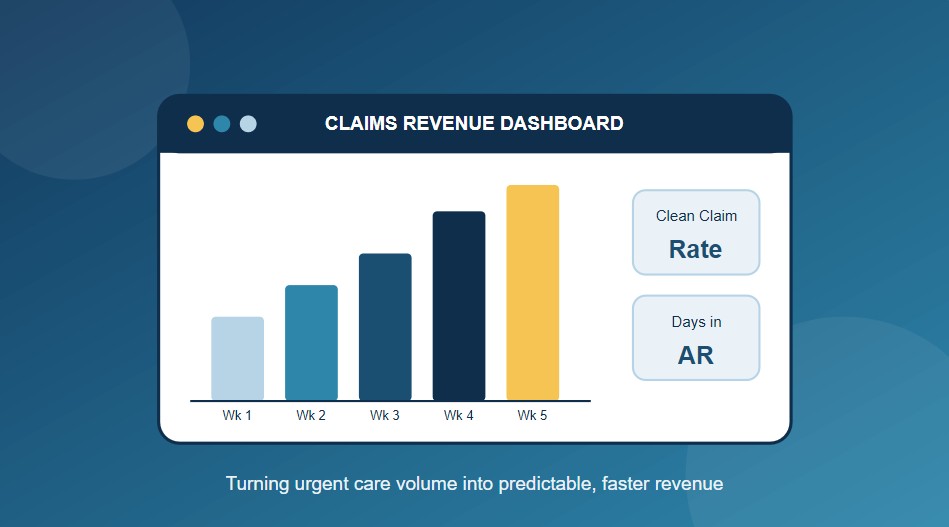
A urgent care center with a strong revenue cycle management strategy will see a clean claims rate that consistently stays high, meaning most claims go out correctly the first time without needing rework. Alongside this, days in accounts receivable should trend downward over time rather than creeping upward as volume grows.
These two numbers work together. A high clean claims rate with a shrinking AR cycle means the practice is both submitting accurate claims and getting paid for them quickly. Watching these signals side by side, rather than looking at total revenue alone, gives a much clearer picture of whether the billing process is keeping pace with patient volume or quietly falling behind it.
A strong urgent care billing strategy shows up everywhere in the practice, not just on a financial report. Providers experience it as fewer billing related questions pulling them away from patient care. Front desk staff experience it as smoother checkouts and fewer awkward conversations about old balances. Leadership experiences it as predictable, faster cash flow that supports staffing and growth instead of constantly chasing down unpaid claims. Treating billing speed as a core part of patient experience, not just a back office function, is what separates urgent care centers that thrive from those that simply stay busy.
At Med Dabster, we help urgent care centers build billing workflows that move as fast as their patients do, so that faster care always turns into faster, more predictable payments.
Urgent care sees a high volume of walk in patients with no advance scheduling, which means eligibility verification, coding, and payer identification all have to happen in real time rather than being handled ahead of a scheduled visit. This compressed timeline leaves little room for error compared to specialties with appointment based scheduling.
Same day or next day submission is the strongest practice, since every extra day a claim sits before going out adds directly to the practice's days in accounts receivable. Weekly batch submission is one of the most common and most avoidable causes of slow urgent care reimbursement.
Common causes include incorrect visit level coding, missing prior authorization, and eligibility issues that were not caught at check in. Tracking denials by root cause rather than just by volume makes it possible to fix the actual source of the problem instead of only reacting to individual denied claims.
Yes, collecting known copays, deductibles, and out of pocket costs at checkout significantly improves patient collections and reduces the amount of revenue that has to be recovered later through statements and follow up calls. Waiting to bill after the visit tends to lower the amount ultimately collected.
Verifying insurance eligibility at the point of care, rather than after the visit, has the largest ripple effect across the entire billing cycle because it prevents downstream coding and claim submission delays before they start. Combined with daily claim submission, it is the most effective way to shorten the time between a patient visit and actual payment.