
A revenue cycle is only as strong as the data flowing through it. Practices that treat data accuracy as a core discipline rather than a clerical afterthought see fewer denials, faster payments, and far less staff time spent chasing corrections.
Every claim a practice submits is really a story told in data points. Patient name, date of birth, insurance ID, provider number, place of service, diagnosis code, procedure code. If even one of these pieces is wrong, outdated, or inconsistent with what the payer has on record, the entire claim can stall, bounce back, or get denied outright. This is why data integrity has quietly become one of the most important and most overlooked drivers of revenue cycle performance.
Most conversations about billing focus on coding accuracy or payer policy. Those things matter, but they sit downstream of something more fundamental: whether the underlying data feeding the claim was correct in the first place. A perfectly coded claim built on a typo in a member ID or an expired insurance record will still fail. Strengthening data integrity is connected to a much broader Revenue Cycle Management strategy, and it pairs closely with the discipline covered in our Medical Billing Guides across specialties.
End-to-end billing optimization →
Reduce no-shows, improve collections →
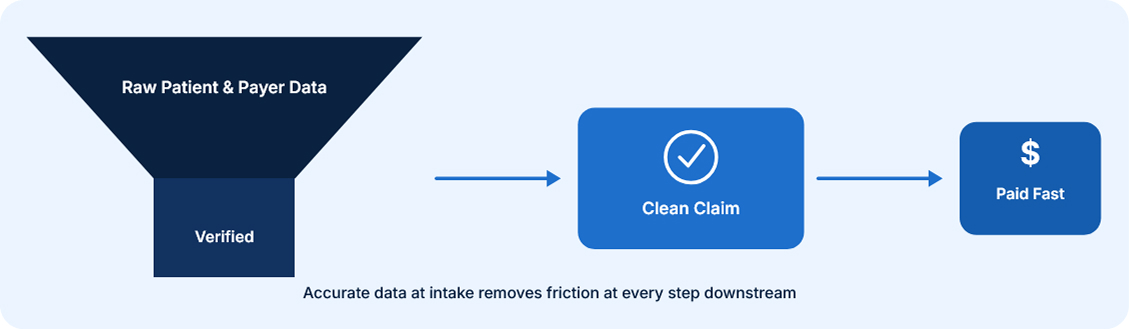
Data integrity is not a single checkbox. It is the combined accuracy, completeness, consistency, and timeliness of every data point attached to a claim. Accuracy means the information is correct. Completeness means nothing required is missing. Consistency means the same patient, provider, and insurance details match across every system that touches the claim. Timeliness means the data reflects the patient's current situation, not what was true six months or six visits ago.
When all four of these hold true, a claim has the best possible chance of being accepted, processed, and paid without a single round of back and forth with the payer. When any one of them breaks down, the claim becomes a candidate for delay, denial, or rework, and rework is where revenue cycle teams lose the most time and money.
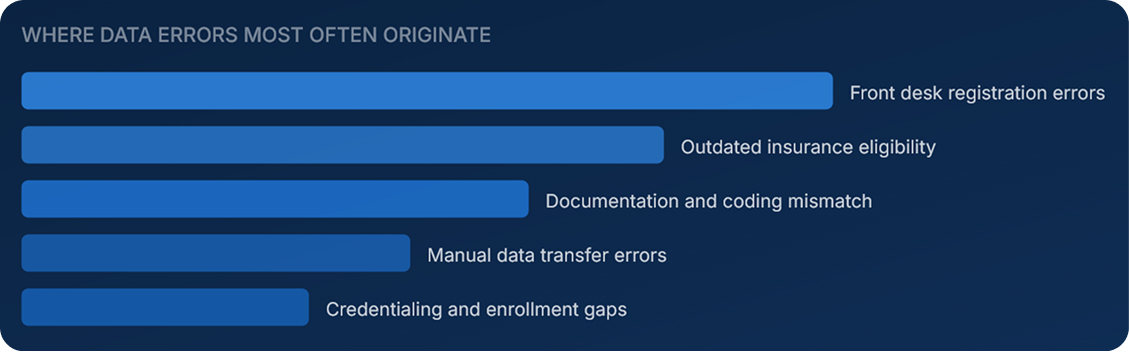
This is the single most common entry point for bad data. A misspelled name, a transposed digit in a date of birth, or an outdated insurance card scanned without verification can quietly travel through the entire claim lifecycle before anyone notices. Registration staff are effectively the first line of defense for the whole revenue cycle, even though they rarely get credit for it.
Verifying eligibility a week before a visit feels proactive, but plans change. A patient may switch jobs, lose coverage, or have a policy lapse between verification and the actual appointment. Eligibility data has a shelf life, and treating it as a one-time task rather than a recurring check is a common source of avoidable denials.
When the clinical note describes one level of service but the billed code reflects another, this is a data mismatch even though it never touches a registration form. Coders are translating documentation into billing language, and if the documentation itself is vague or incomplete, the resulting code carries that uncertainty forward into the claim.
Many practices still move information by hand between an EHR, a practice management system, and a clearinghouse portal. Every manual transfer is an opportunity for a typo, a dropped field, or a formatting mismatch that a payer's system will flag immediately.
Claims can be denied simply because a provider's enrollment with a specific payer lapsed, was never updated after a name or address change, or does not match the billing NPI used on the claim. This type of data error has nothing to do with the patient encounter itself, yet it stops payment just as effectively.
A clean claim is simply a claim that a payer accepts and processes on the first submission without requesting more information or returning it for correction. The path to a clean claim runs directly through data integrity. Every accurate field reduces the surface area for a payer's automated edits to flag something. Every verified detail removes one more reason for a claim to be pulled aside for manual review.
Practices sometimes assume clean claim rates are mostly a coding issue, but coding accuracy depends on data accuracy further upstream. A correctly chosen CPT code attached to the wrong patient identifier, or paired with an expired authorization number, still produces a denial. Clean claims are the output of a clean data pipeline, not the result of coding skill alone.
Every claim that is rejected or denied due to a data error has to be corrected and resubmitted, which can push payment back weeks or even months from the original date of service.
Billing teams spend a disproportionate amount of time chasing down corrections for issues that could have been prevented with a five minute verification at the front desk.
When claim status data is unreliable, leadership cannot trust the accounts receivable reports they rely on for cash flow planning and staffing decisions.
Inconsistent or inaccurate data trails can complicate audit responses and make it harder to demonstrate that billed services match documented and authorized care.
Strong data integrity is not a one-time project. It is a continuous discipline built into daily workflows. The practices that perform best treat it as a process with checkpoints, not a single intake form filled out once and forgotten.
Re-confirming demographic and insurance details at each encounter, even for returning patients, catches the small changes that accumulate into big problems. A returning patient with a new employer or a changed address is far more common than most front desk teams expect.
Automated scrubbing tools check claims against payer-specific rules before they ever leave the building. Catching a missing modifier or mismatched code internally takes minutes. Catching the same issue after a payer rejection can take weeks.
When coders or billers regularly find documentation gaps, that feedback needs to travel back to clinical staff so the same gap does not repeat on the next patient. Practices that treat coding and clinical documentation as separate silos tend to see the same errors recur indefinitely.
Periodic internal audits, even informal ones, reveal patterns that day-to-day work can hide. If a particular payer, provider, or service line shows a recurring denial pattern tied to data issues, that pattern is usually visible only when someone steps back and looks at trends rather than individual claims.
Worth noting: Many practices invest heavily in coding training while underinvesting in front-end data verification. Coding accuracy can only protect a claim that is already built on correct underlying data. Strengthening the front end of the revenue cycle often produces a faster improvement in clean claim rates than any amount of additional coding review.
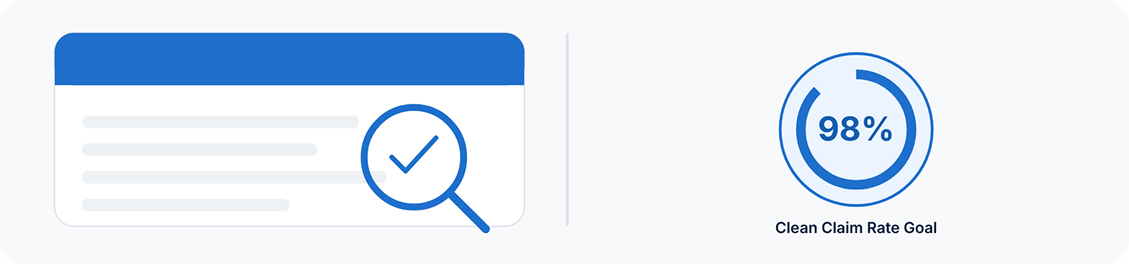
The clearest sign that data integrity is improving is a rising first-pass clean claim rate, meaning the percentage of claims accepted and paid without correction or appeal. Alongside this metric, days in accounts receivable typically shorten, since fewer claims are stuck in correction cycles. Denial rates tied specifically to eligibility, demographic, or registration errors should trend downward as a direct, measurable result.
These metrics work together. A practice cannot meaningfully improve days in accounts receivable while ignoring the data quality issues feeding denials in the first place, and it cannot sustainably raise clean claim rates without addressing the root causes at registration and documentation. Tracking these numbers together, rather than in isolation, gives a much clearer picture of where the revenue cycle actually breaks down.
Data integrity in billing is often framed as a back-office concern, but its effects ripple outward. Patients experience it as confusing bills or unexpected balances when insurance information was wrong. Providers experience it as delayed payment for work already completed. Leadership experiences it as unreliable financial reporting that makes planning difficult. Treating data integrity as a practice-wide priority, rather than something confined to the billing team, is what separates organizations with consistently strong revenue cycle performance from those constantly fighting denials after the fact.
At Meddabster, we build data verification checkpoints directly into the billing workflows we manage for our partner practices, so that issues are caught and corrected before a claim is ever submitted rather than after a denial arrives. This proactive approach is a core part of how we support stronger Revenue Cycle Management services for the practices we work with.
Data integrity in medical billing means that every piece of information tied to a claim, including patient demographics, insurance details, provider identifiers, and procedure and diagnosis codes, is accurate, complete, consistent, and current at the moment the claim is submitted. It is the foundation that everything downstream in the revenue cycle depends on, since even one inaccurate field can cause an otherwise well-coded claim to fail.
A clean claim is one that is accepted and processed by a payer on the first submission without requiring additional information, correction, or manual intervention. Clean claims move through adjudication faster and get paid sooner because there is nothing for the payer to question, request more information about, or kick back for resubmission.
Poor data quality leads to denials when information submitted on a claim does not match what the payer has on file or does not meet coding and coverage rules. Common triggers include mismatched patient identifiers, outdated insurance information, incorrect provider numbers, and diagnosis codes that do not adequately support the procedure being billed.
Data integrity is a shared responsibility across front desk staff who collect patient and insurance information, clinical staff who document care, coders who translate that documentation into billing codes, and billing teams who submit and follow up on claims. No single department can maintain it alone, which is why communication between these teams matters as much as any individual step.
Best practice is to verify patient demographic and insurance information at every visit, not just at initial registration. Insurance coverage, employer-sponsored plans, and even patient contact details change frequently, and verifying at each encounter catches these changes before a claim is submitted rather than after it bounces back.
Technology supports data integrity through automated eligibility checks, claim scrubbing software that flags errors before submission, integration between practice management and clearing house systems, and analytics dashboards that surface recurring error patterns. Technology reduces manual entry errors but still requires trained staff to interpret and act on what it flags, since automated tools cannot resolve underlying process gaps on their own.


